POLLUTEv10 Examples

POLLUTEv10 layered contaminant transport model and calculated concentration results
20 Documented Models

Learn POLLUTEv10 through Progressive, Reviewable Examples

Move from fundamental diffusion models to engineered landfill systems, fractured media and uncertainty analysis.

Each example explains the conceptual model, assumptions, inputs and result interpretation. Filter the library by application or search for a transport process.

20 ExamplesFoundation through advanced
5 Landfill ModelsLiners and collection systems
6 Advanced CasesReactive and changing systems
4 Review CasesBenchmarks and uncertainty
Example Library

Find a Model by Application or Process

Start with the simplest example that contains the process you need, then progress to more complex configurations.

Showing 20 examples

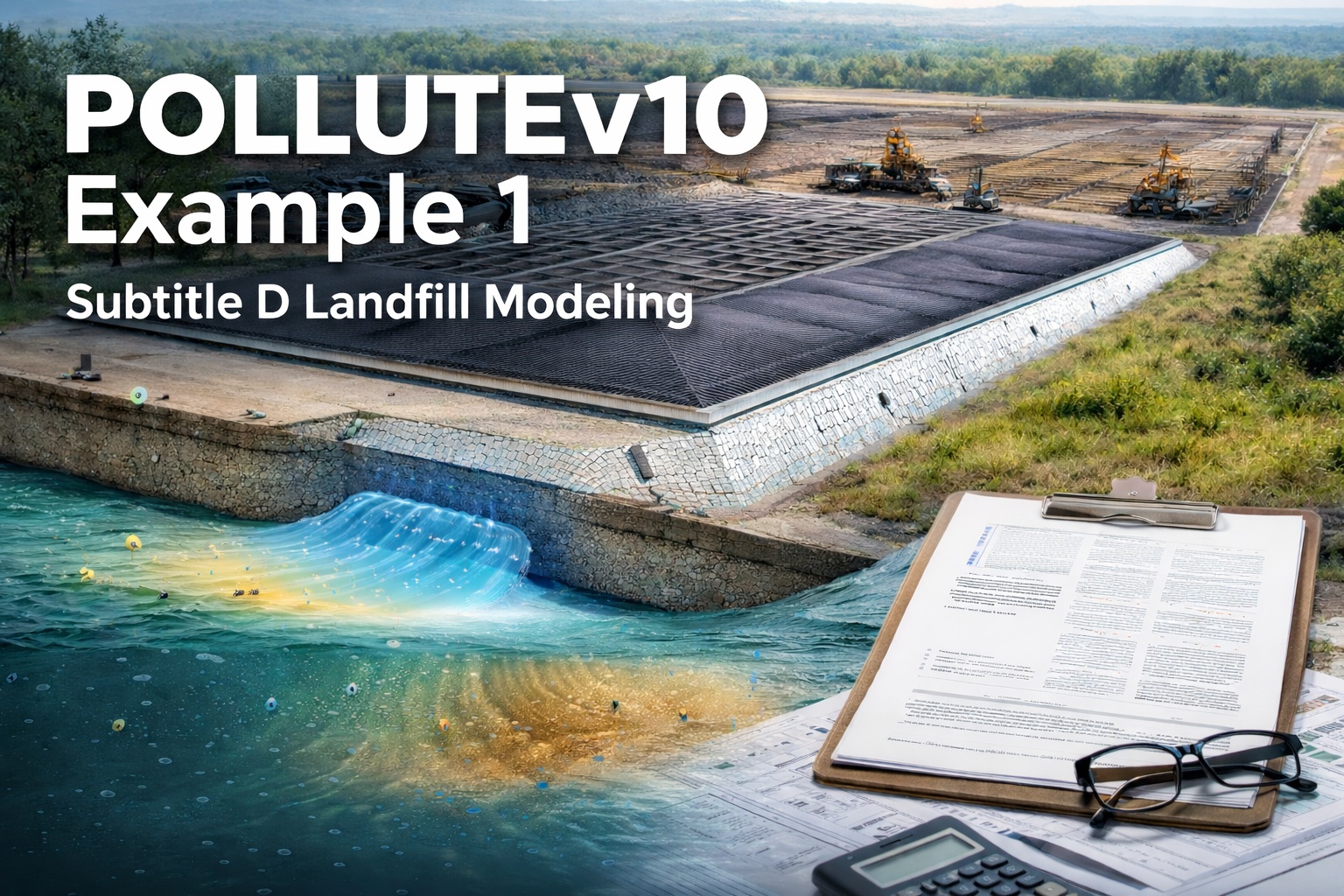
POLLUTEv10 Example 1: U.S. RCRA Subtitle D Landfill
Landfill SystemsComposite liner

Example 1: U.S. RCRA Subtitle D Landfill

Composite liner, primary leachate collection and aquifer impact in a foundational landfill assessment.

Open documented example


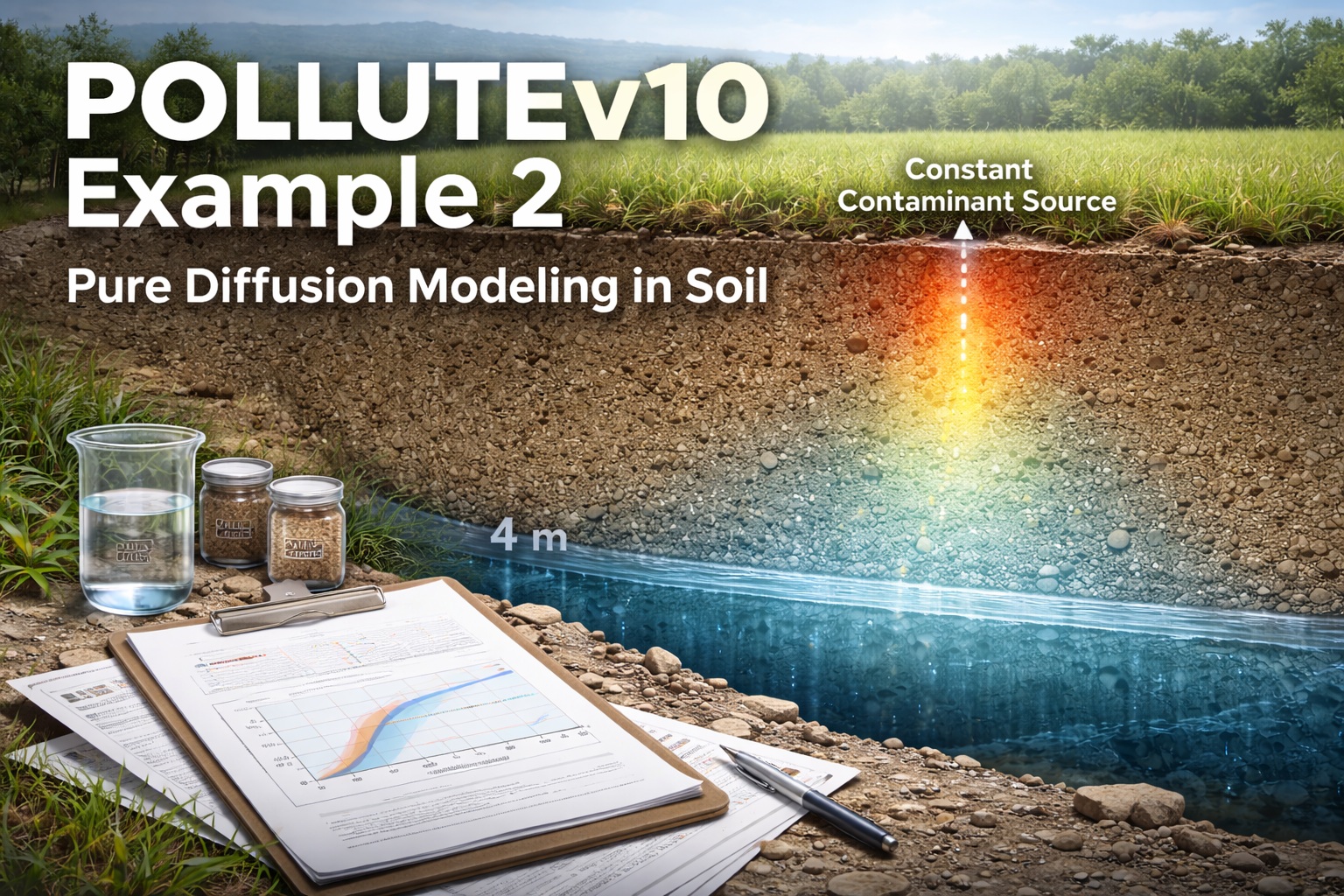
POLLUTEv10 Example 2: Pure Diffusion in Soil
FundamentalsPure diffusion

Example 2: Pure Diffusion in Soil

A conservative contaminant moving through a soil layer without sorption or advective flow.

Open documented example
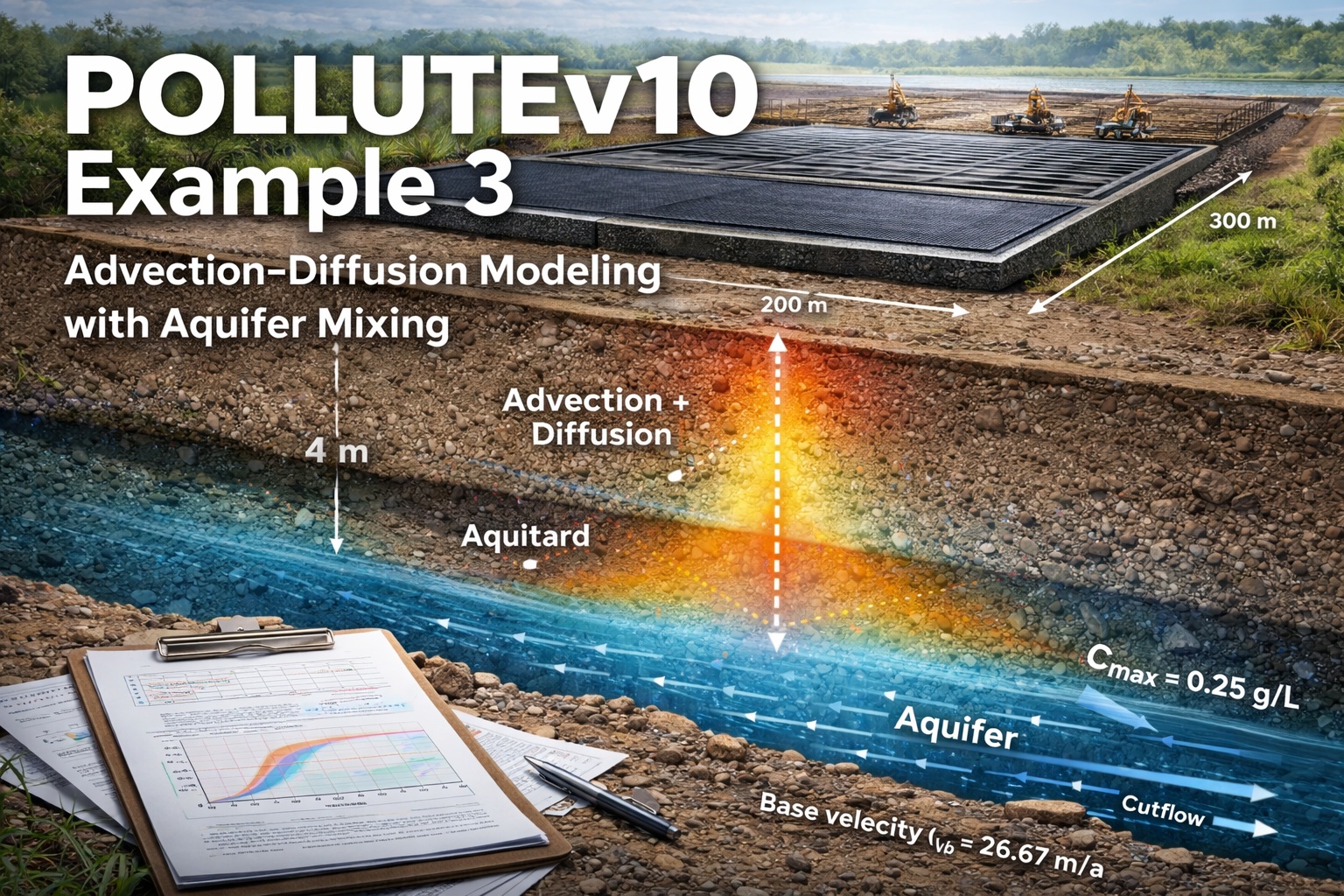
POLLUTEv10 Example 3: Advection, Diffusion and Aquifer Mixing
FundamentalsAquifer mixing

Example 3: Advection, Diffusion and Aquifer Mixing

Adds groundwater flow and a permeable aquifer boundary to the diffusion model.

Open documented example
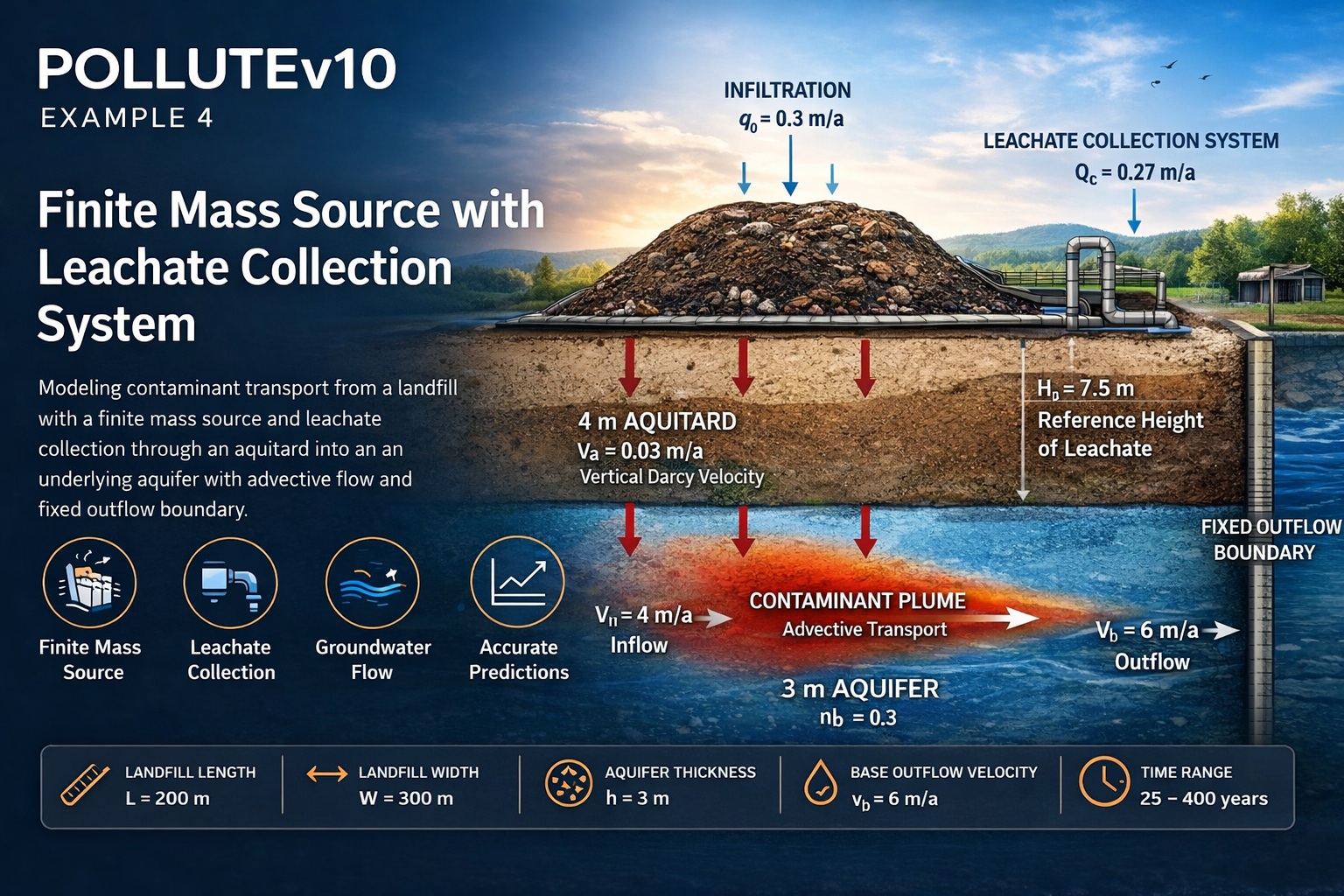
POLLUTEv10 Example 4: Finite Mass Source with Leachate Collection
Landfill SystemsFinite source

Example 4: Finite Mass Source with Leachate Collection

Represents a depleting source and active leachate collection in an engineered landfill.

Open documented example
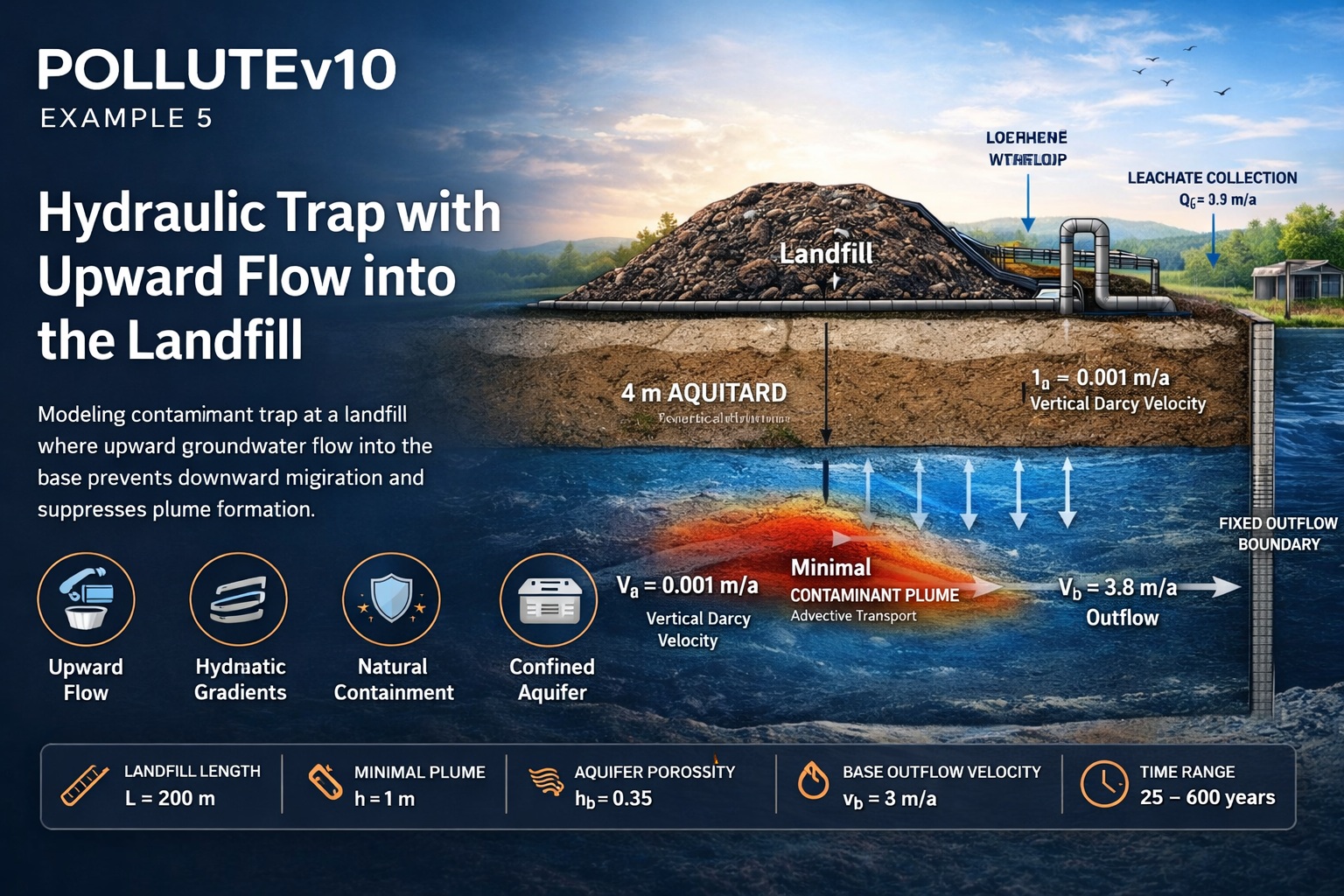
POLLUTEv10 Example 5: Hydraulic Trap with Upward Flow
FundamentalsHydraulic trap

Example 5: Hydraulic Trap with Upward Flow

Examines contaminant containment where groundwater flow opposes downward migration.

Open documented example
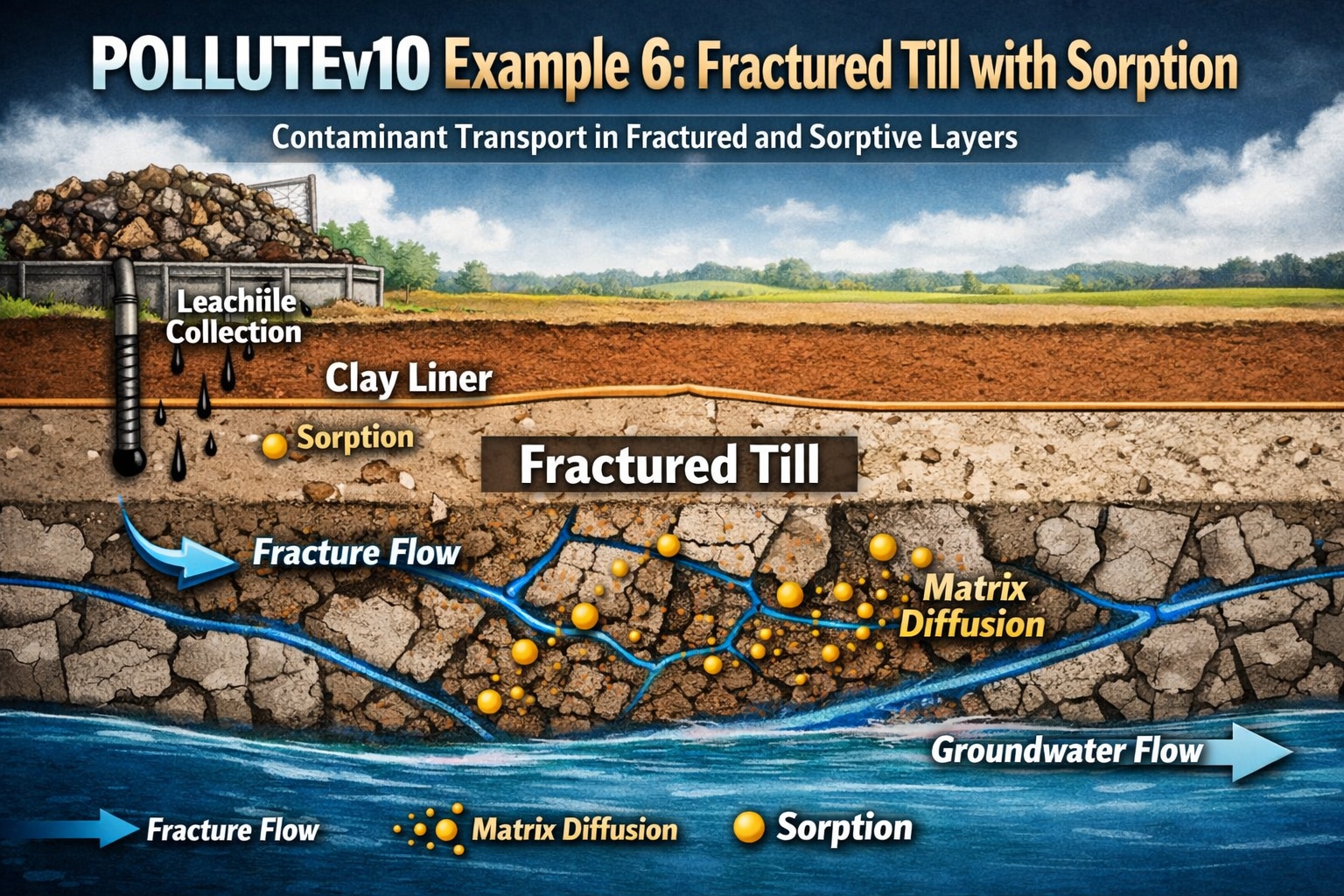
POLLUTEv10 Example 6: Fractured Layer with Sorption
Advanced TransportFractured media

Example 6: Fractured Layer with Sorption

Combines transport in fractured till with reactive sorption below an engineered liner.

Open documented example
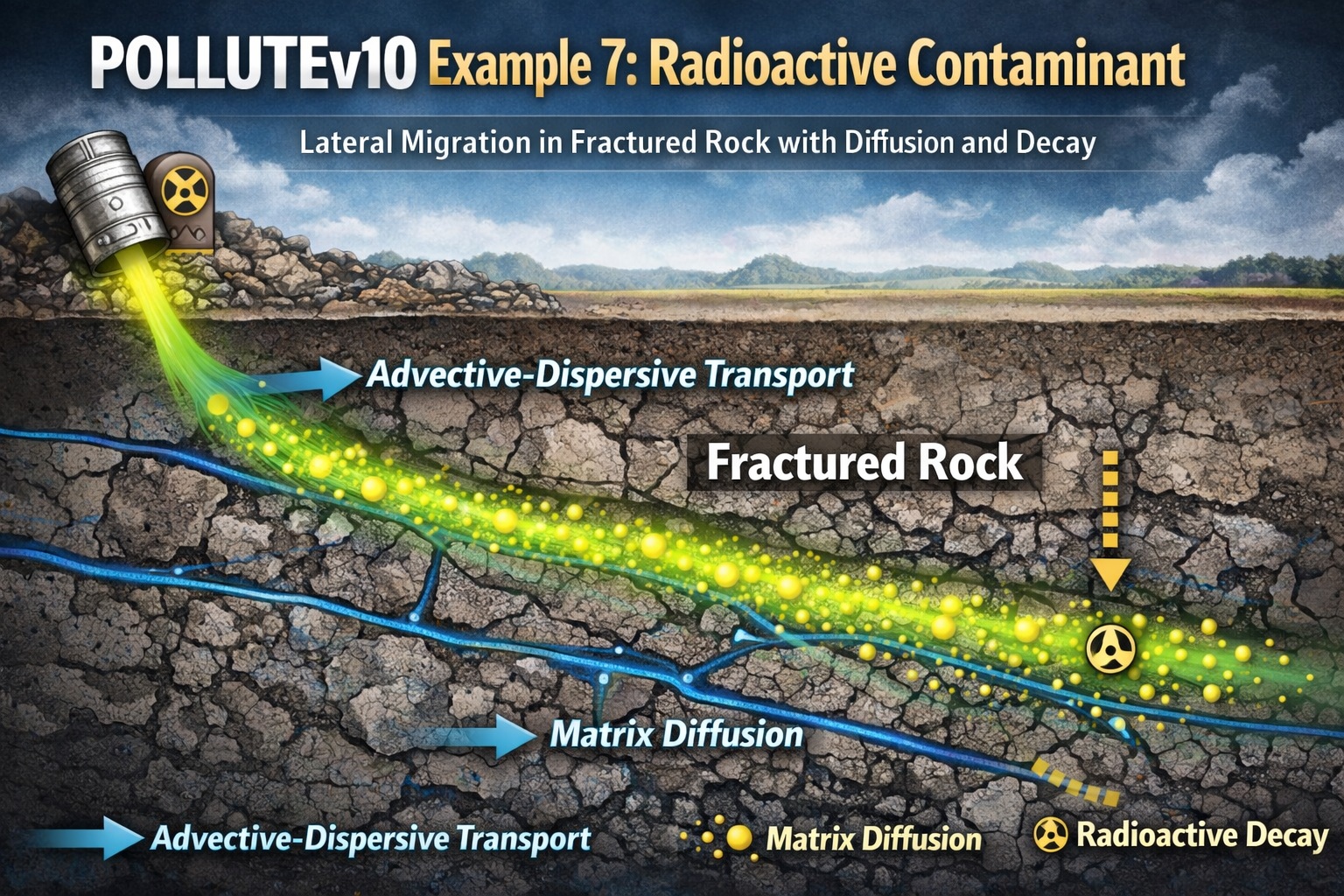
POLLUTEv10 Example 7: Radioactive Contaminant in Fractured Rock
Advanced TransportDecay and fractures

Example 7: Radioactive Contaminant in Fractured Rock

Models lateral fracture transport, matrix diffusion and radioactive decay.

Open documented example
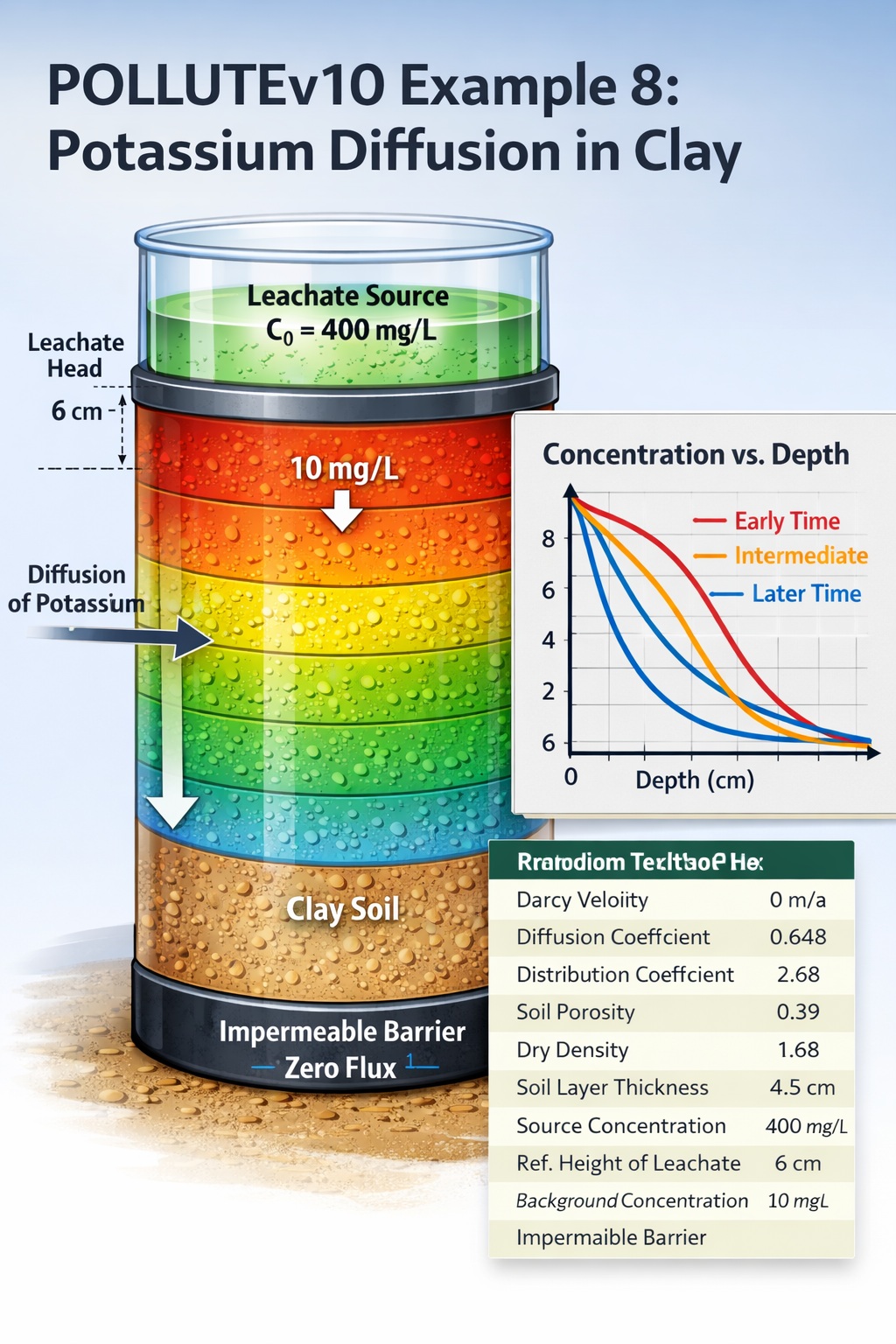
POLLUTEv10 Example 8: Laboratory Potassium Diffusion in Clay
FundamentalsLaboratory diffusion

Example 8: Laboratory Potassium Diffusion in Clay

Reproduces a controlled diffusion test through saturated clay with an impermeable base.

Open documented example
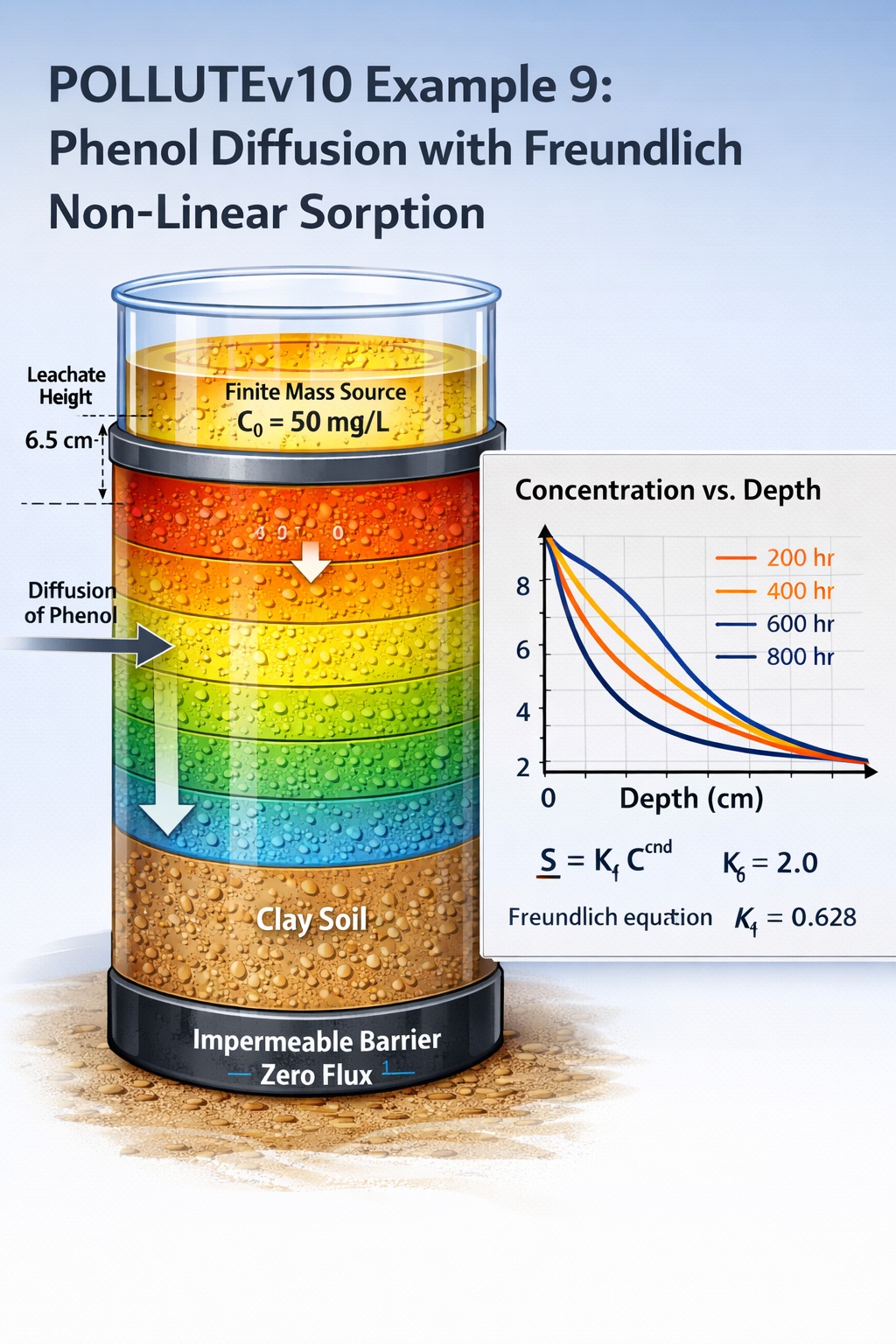
POLLUTEv10 Example 9: Phenol Diffusion with Freundlich Sorption
FundamentalsNonlinear sorption

Example 9: Phenol Diffusion with Freundlich Sorption

Demonstrates concentration-dependent nonlinear sorption during diffusion through clay.

Open documented example
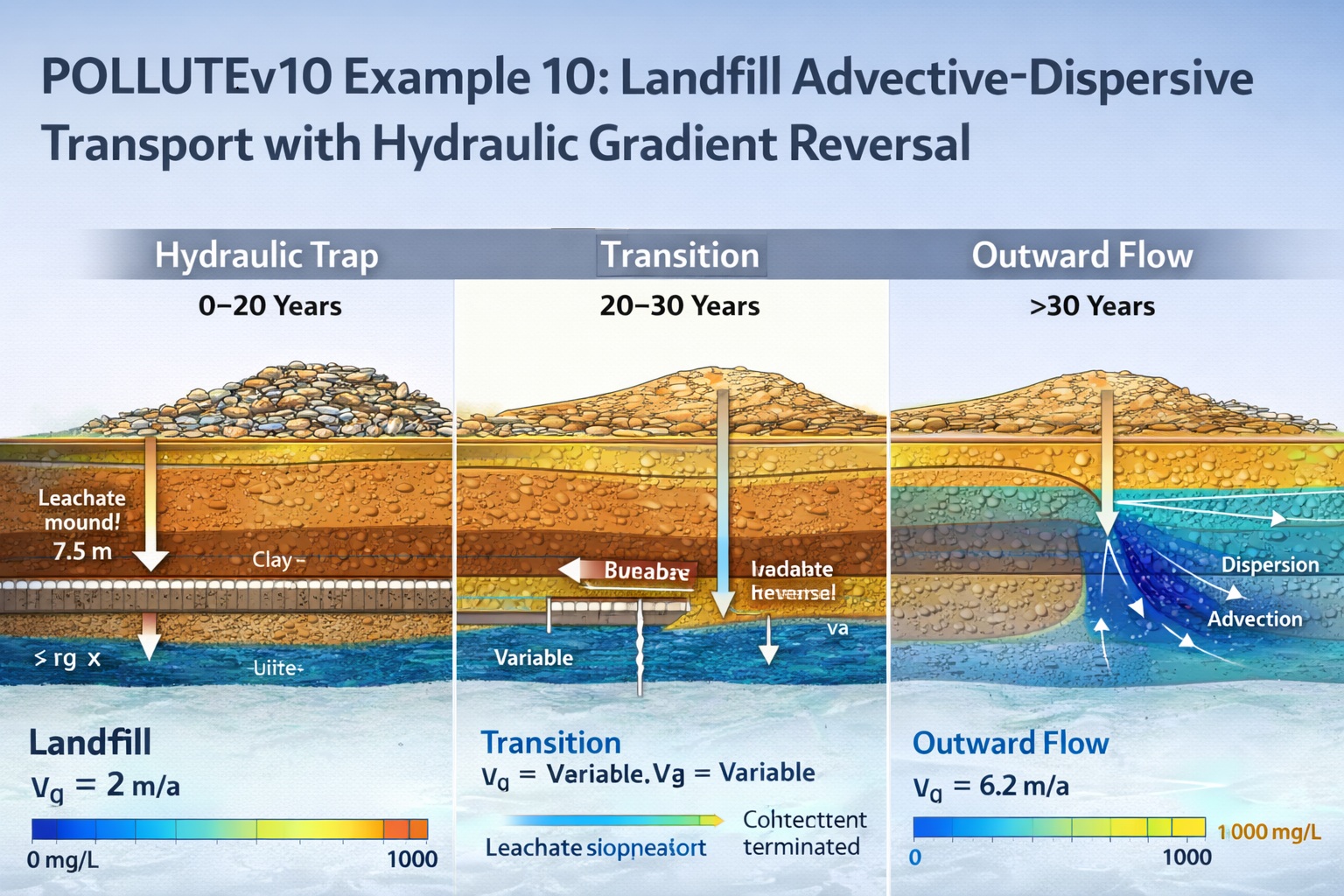
POLLUTEv10 Example 10: Time-Varying Advective–Dispersive Transport
Advanced TransportVariable properties

Example 10: Time-Varying Advective–Dispersive Transport

Uses variable properties to represent changing landfill flow and transport conditions.

Open documented example
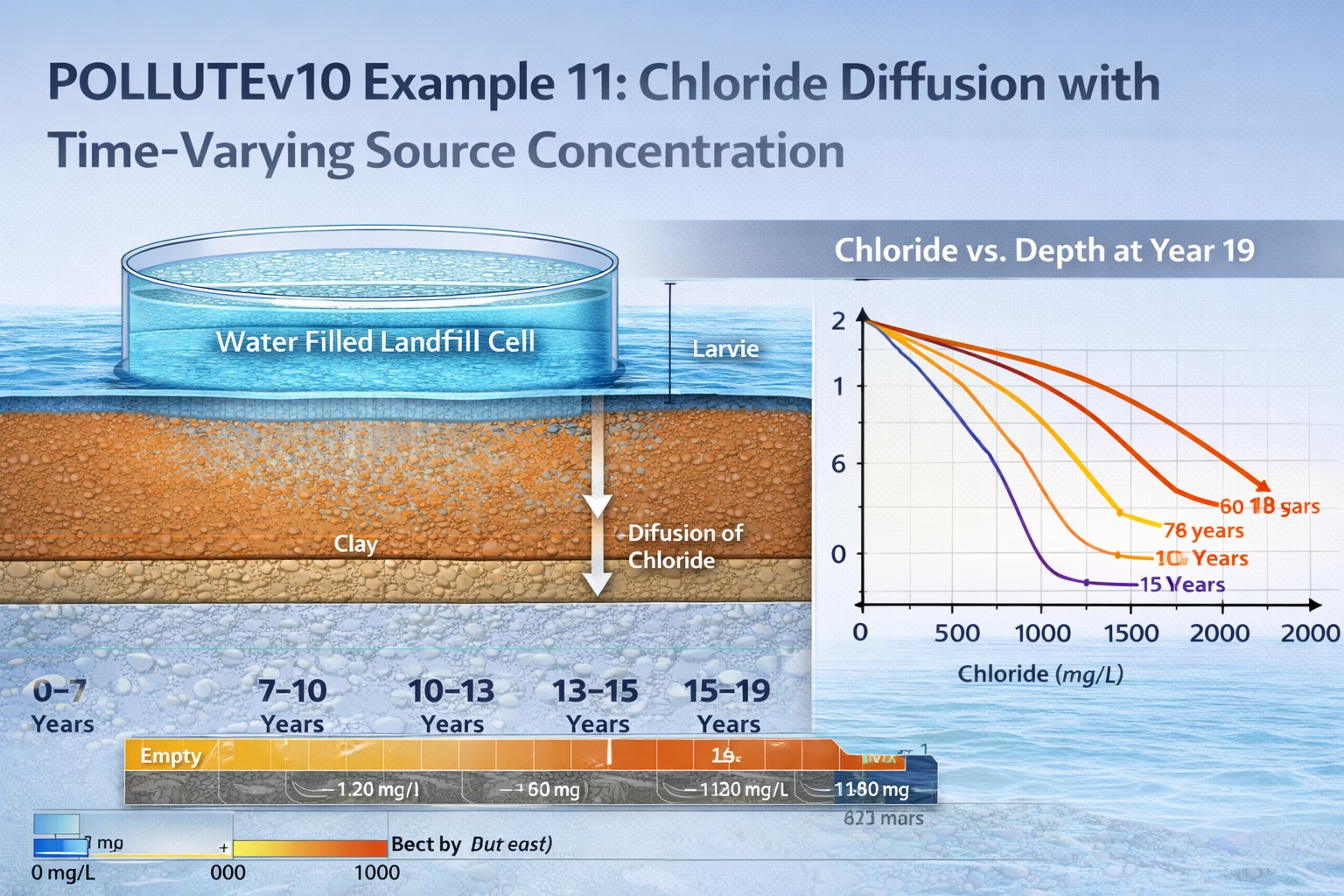
POLLUTEv10 Example 11: Time-Varying Chloride Source in Clay
Advanced TransportChanging source

Example 11: Time-Varying Chloride Source in Clay

Models a changing source history under diffusion-only conditions in clay.

Open documented example
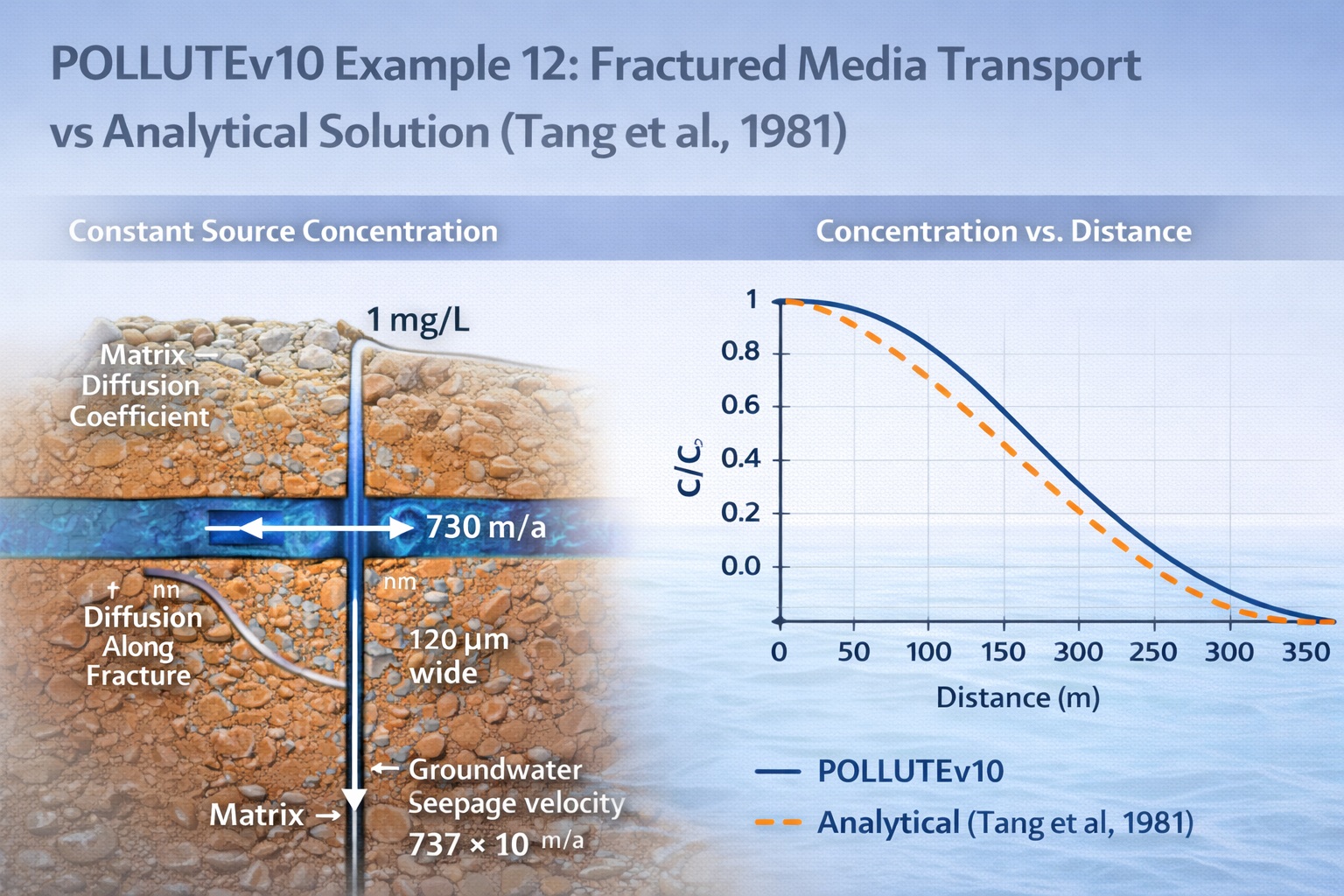
POLLUTEv10 Example 12: Fractured Media Analytical Benchmark
Benchmarks & UncertaintyAnalytical benchmark

Example 12: Fractured Media Analytical Benchmark

Compares fracture–matrix transport with the Tang et al. analytical solution.

Open documented example
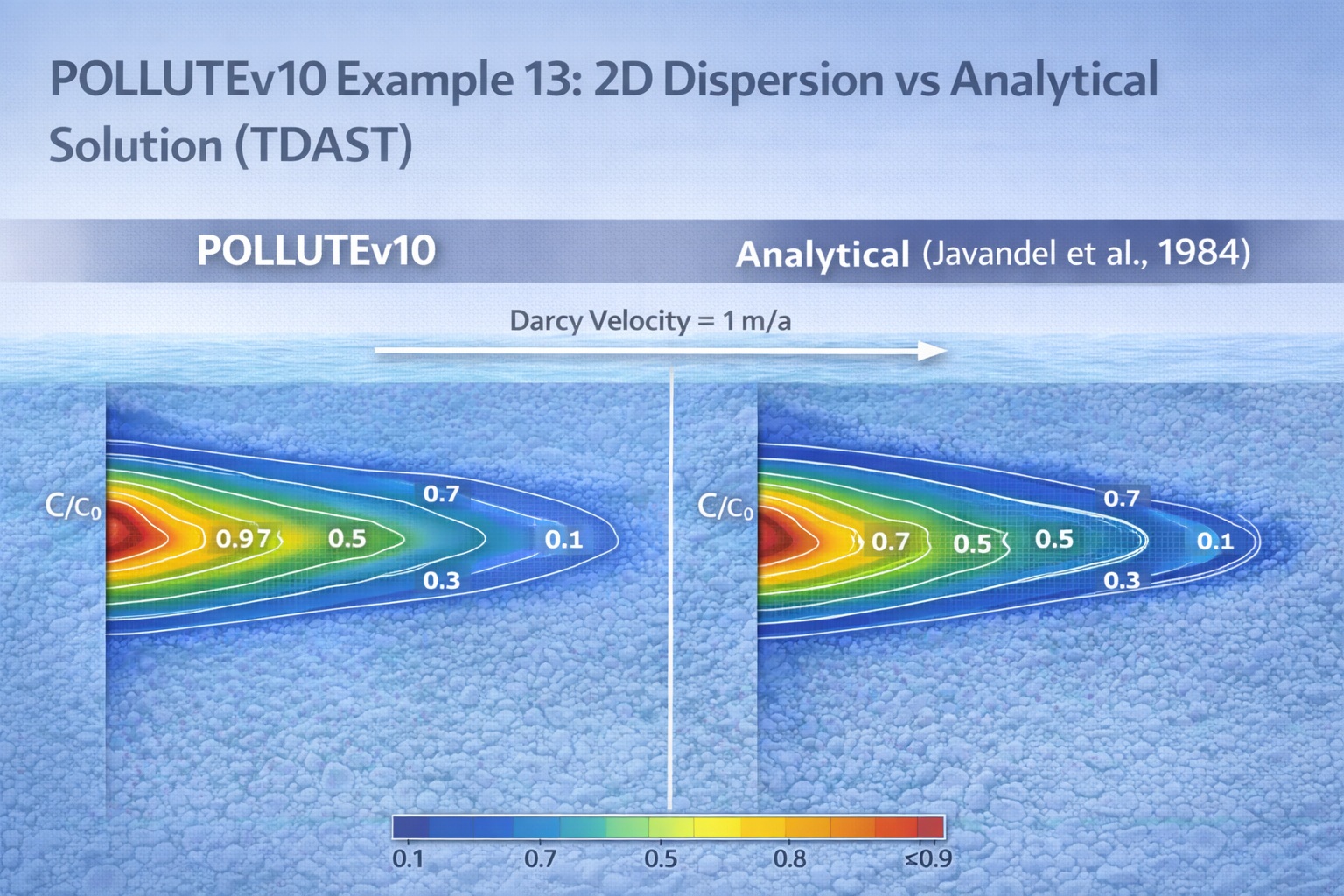
POLLUTEv10 Example 13: 2D Plane Dispersion Benchmark
Benchmarks & UncertaintyDispersion benchmark

Example 13: 2D Plane Dispersion Benchmark

Compares the documented plane-dispersion formulation with the TDAST analytical solution.

Open documented example
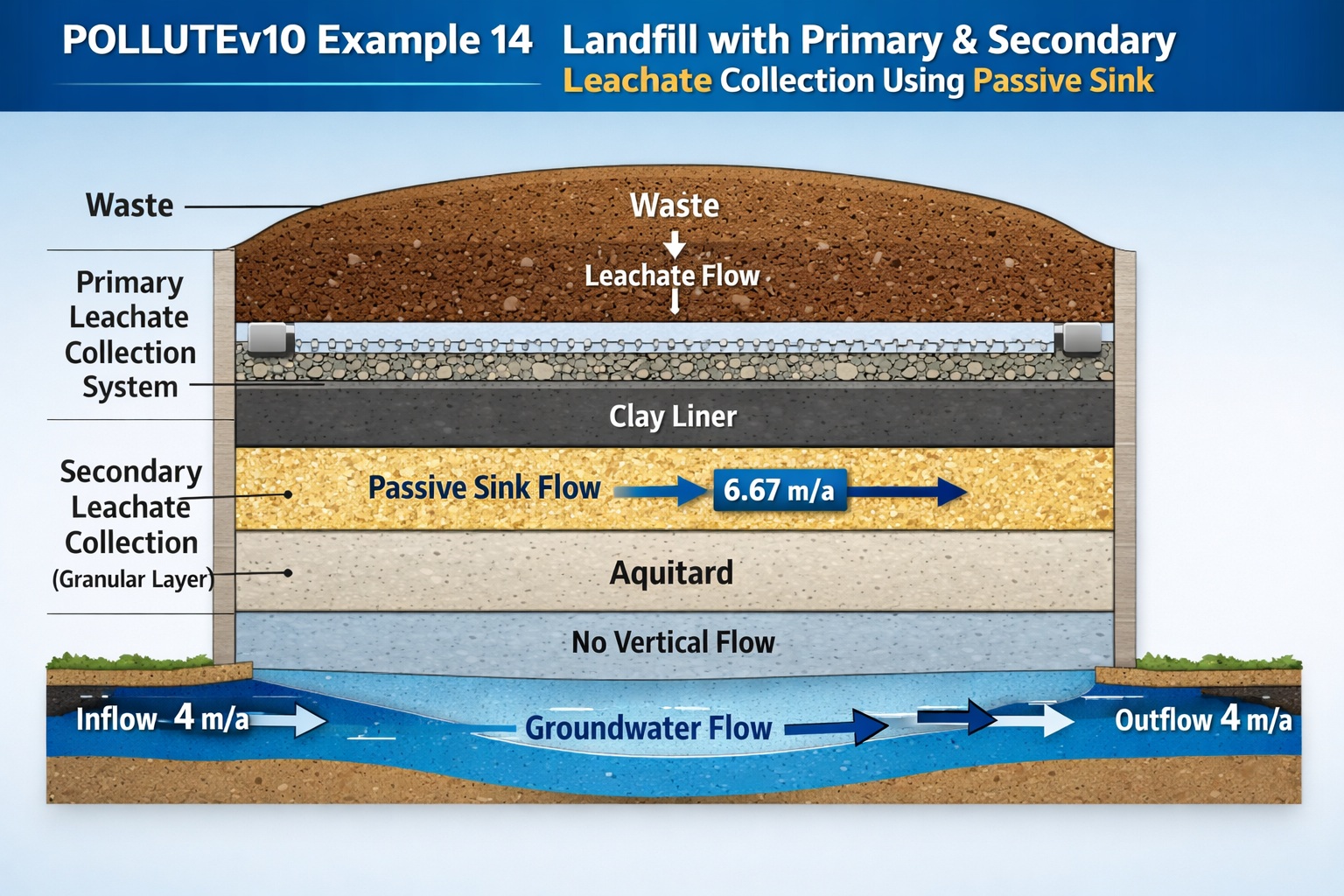
POLLUTEv10 Example 14: Primary and Secondary Collection with Passive Sink
Landfill SystemsPassive sink

Example 14: Primary and Secondary Collection with Passive Sink

Uses a passive sink to represent contaminant removal by a secondary collection layer.

Open documented example
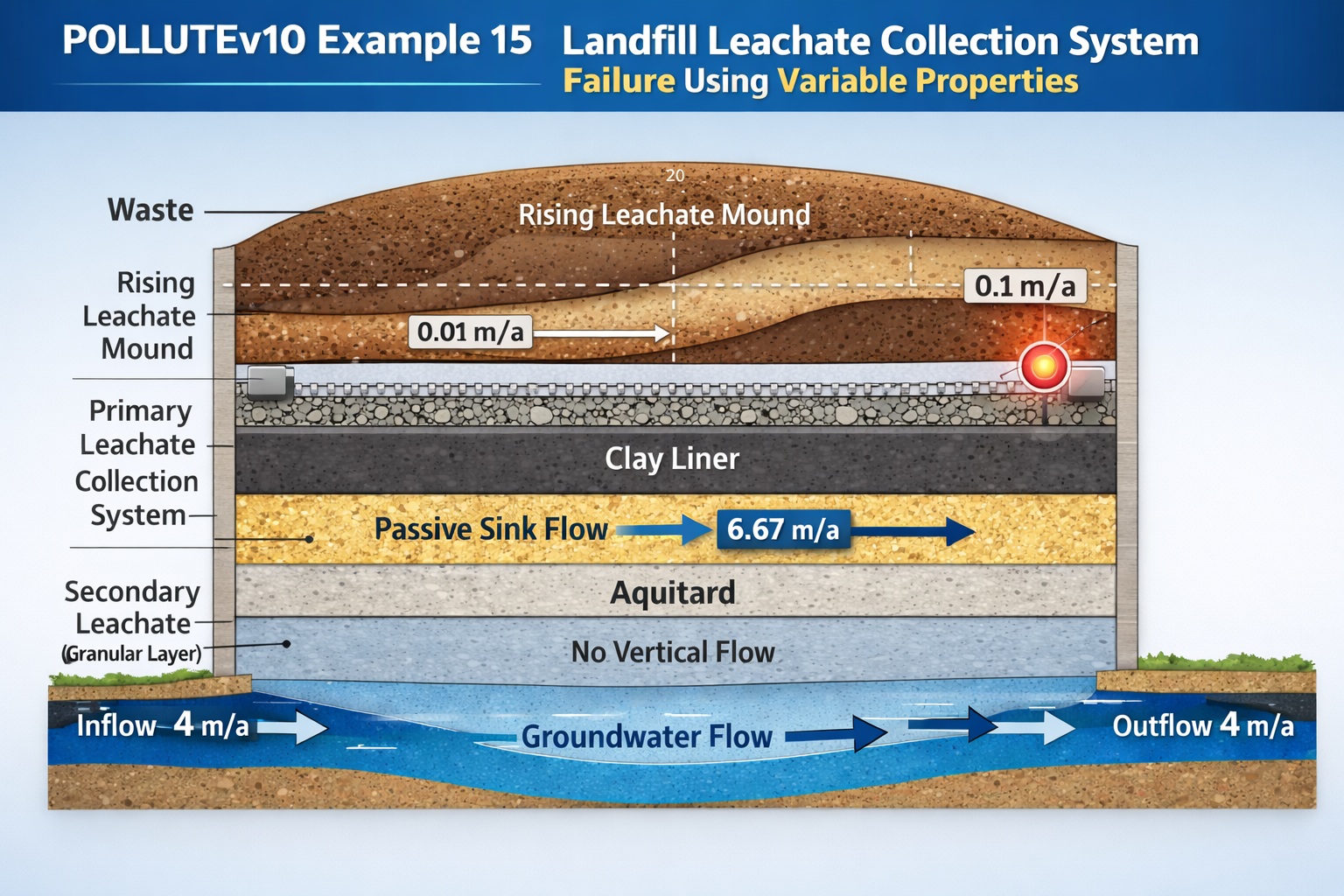
POLLUTEv10 Example 15: Leachate Collection System Failure
Landfill SystemsSystem degradation

Example 15: Leachate Collection System Failure

Combines variable properties and a passive sink to represent time-dependent system failure.

Open documented example
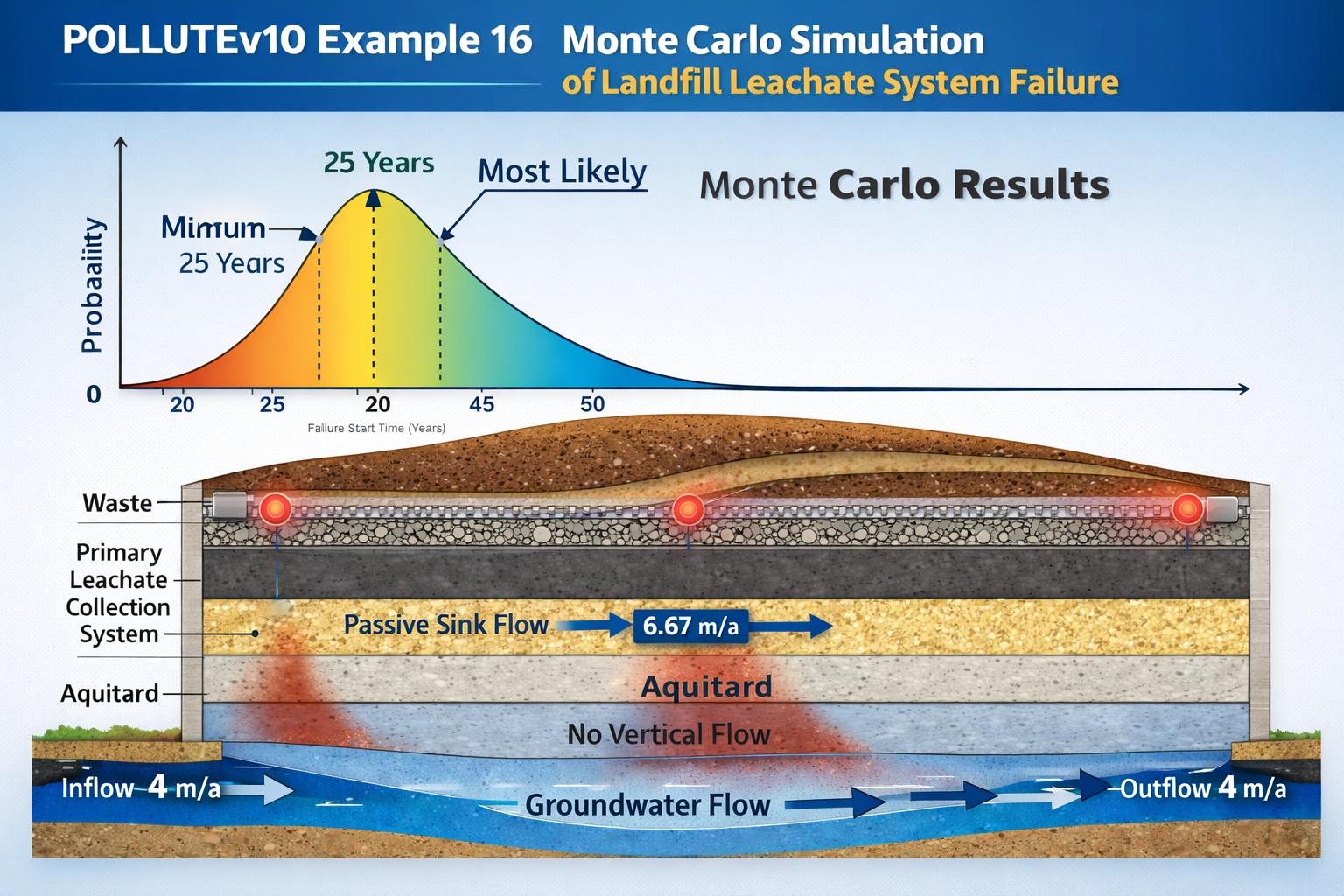
POLLUTEv10 Example 16: Monte Carlo Analysis of Failure Timing
Benchmarks & UncertaintyMonte Carlo

Example 16: Monte Carlo Analysis of Failure Timing

Evaluates uncertainty in collection-system failure time using probabilistic simulation.

Open documented example
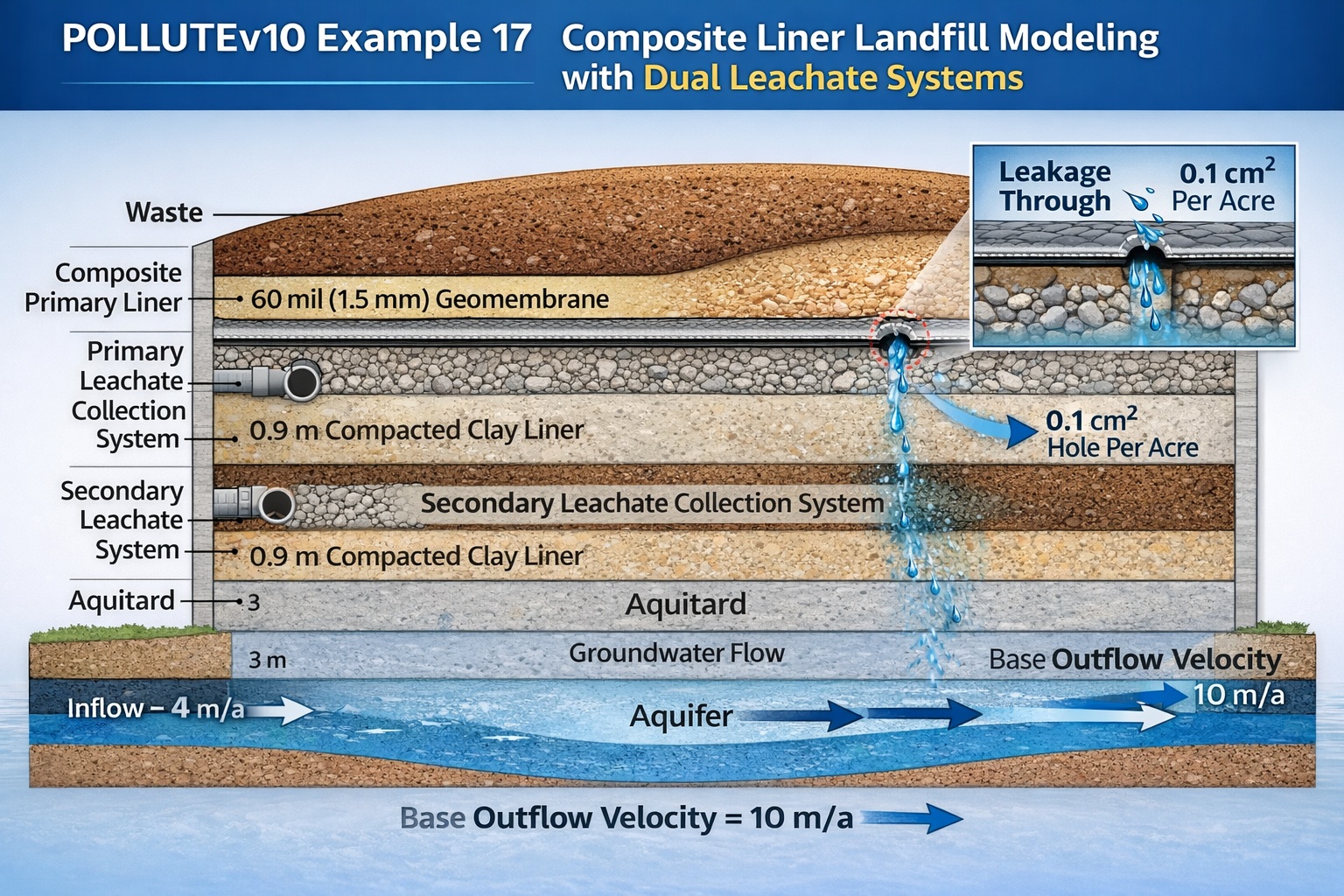
POLLUTEv10 Example 17: Composite Liners and Dual Collection Systems
Landfill SystemsMulti-barrier design

Example 17: Composite Liners and Dual Collection Systems

Represents a modern multi-barrier landfill with primary and secondary collection.

Open documented example
POLLUTEv10 Example 18: Phase Change in a Secondary Collection System
Advanced TransportPhase change

Example 18: Phase Change in a Secondary Collection System

Examines phase partitioning, unsaturated and saturated zones and biological decay.

Open documented example
POLLUTEv10 Example 19: Multiphase Toluene Diffusion through a Geomembrane
Advanced TransportMultiphase diffusion

Example 19: Multiphase Toluene Diffusion through a Geomembrane

Reproduces laboratory-scale VOC transport through geomembrane, air and water zones.

Open documented example
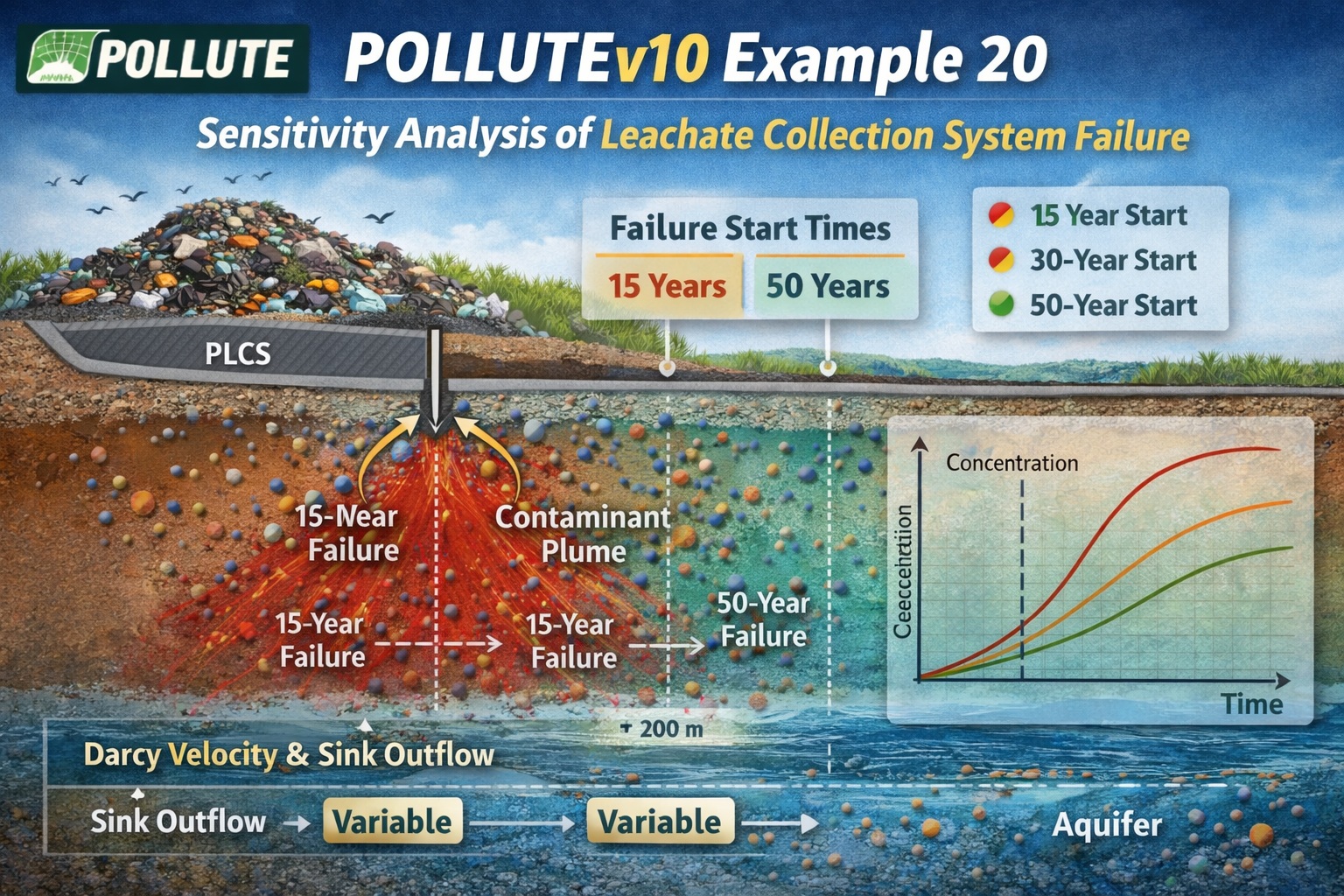
POLLUTEv10 Example 20: Sensitivity Analysis of Collection-System Failure
Benchmarks & UncertaintySensitivity analysis

Example 20: Sensitivity Analysis of Collection-System Failure

Tests how assumed primary collection-system service life affects predicted impacts.

Open documented example
Instructional examples are not design standards. Adapt the conceptual model and parameters to site-specific conditions and have the resulting engineering interpretation reviewed by a qualified professional.
Suggested Learning Path

Build Understanding in Four Stages

1

Transport Foundations

Begin with Examples 2, 3 and 5 to isolate diffusion, advection, aquifer mixing and hydraulic direction.

2

Sources and Sorption

Use Examples 4, 8 and 9 to examine finite mass, laboratory diffusion and nonlinear sorption.

3

Engineered Systems

Progress through Examples 1, 14, 15 and 17 for liners, sinks and collection-system performance.

4

Advanced Review

Use Examples 12, 13, 16 and 20 for benchmarks, probabilistic analysis and sensitivity.

Selecting a Starting Point

Match the Example to the Engineering Question

  • Identify whether transport is diffusion-dominated, advective or mixed
  • Determine whether the source is constant, finite or time-varying
  • Choose the required liner, collection and aquifer boundaries
  • Identify sorption, decay, fractured-media or phase-change processes
  • Decide whether a deterministic, sensitivity or probabilistic analysis is needed
  • Confirm that POLLUTE’s 1D/1.5D formulation fits the spatial problem

Recommended Use of an Example

  1. Reproduce the documented case.
  2. Check that its results and trends are understood.
  3. Save an unchanged reference copy.
  4. Replace inputs with project-supported values.
  5. Test one change at a time.
  6. Document differences and limitations.
Continue Learning

Connect Examples to Product Guidance

Core Features

Review model layers, source and receptor boundaries, templates and output.

Explore Core Features

Special Features

Understand advanced processes used by the later examples.

Explore Special Features

Complete Knowledge Center Archive

Browse the original articles and related contaminant-modeling guidance.

Open the archive

POLLUTE and MIGRATE

Compare the 1D/1.5D and 2D approaches for the project question.

Compare the products

Upgrade Guidance

Plan migration from POLLUTE v7 or MIGRATE v9.

Review Upgrades

Technical Support

Ask about model configuration, installation or product evaluation.

Contact Technical Support

Ready to Reproduce an Example in POLLUTEv10?

Start with the closest documented case, verify its behavior and then introduce project-specific assumptions.