|
<< Click to Display Table of Contents >> Munsell Colors |
  
|
|
<< Click to Display Table of Contents >> Munsell Colors |
|
The Munsell color system specifies colors based on three properties: hue (basic color), value (lightness), and chroma (purity). It was created by Albert H. Munsell in the first decade of the 20th century and adopted by the United States Department of Agriculture (USDA) as the official color system for soil research in the 1930s.
The hue is noted as the letter abbreviation of the color of the rainbow (e.g. R for red). The quality of the color is modified by the preceding value (0-10). Value (lightness) is rated on a scale from 0 to 10, with 0 being black and 10 being white. And the chroma consists of a scale with lower numbers being more washed out (less pure).
A color is fully specified using the three properties for hue, value, and chroma. The hue is specified using the hue number and hue prefix. For each color and optional description can be specified.
To display and specify descriptions for the Munsell colors select Tools > Other > Munsell Colors. The Munsell Color form below will be displayed.
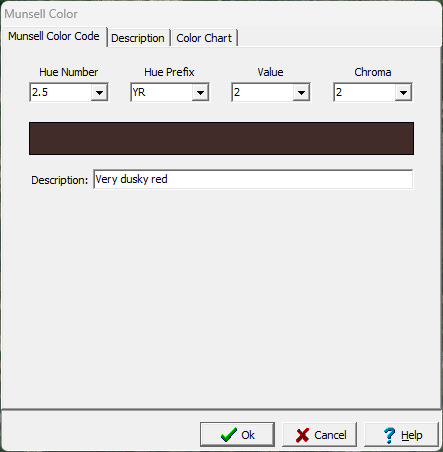
This form has three tabs for displaying and selecting Munsell Colors as described in the sections below.